AI Makes Parallelism Cheap; It Also Makes Prioritization Expensive

A few years ago, “moving faster” meant hiring more engineers.
Now it means… adding a Copilot seat.
So yes—AI makes parallelism cheap. We can spin up more drafts, more prototypes, more Terraform plans, more PRs, more experiments—in the time it takes to finish a coffee and pretend you’re reading the Teams Channel thread.
But here’s the twist nobody puts on the slide:
When production becomes cheap, selection becomes expensive.
And that “selection” is… prioritization.
The new bottleneck isn’t code. It’s a choice.
In the old world, engineering had a natural throttle:
- limited hands
- limited time
- limited context
- limited throughput
So the backlog stayed “aspirational.” A lot of ideas died peacefully in Jira without ever seeing a branch name.
In the AI world, ideas don’t die. They compile.
Suddenly:
- Your team can open 2x the number of PRs
- infra can be created as fast as you can describe it
- “small enhancements” multiply like rabbits
- Every product request sounds “almost done” because an agent already scaffolded it
Faros found that teams with high AI adoption touch 47% more pull requests per day (and more tasks too). faros.ai
That sounds like productivity… until you realize what it really means:
The “More PRs/day” trap: when throughput turns into traffic
We use GitHub. We use Copilot. We use PR review agents. We use Claude agents for coding assistance. We generate Terraform modules. We ship through AWS pipelines.
So trust me, I love speed.
But when PR volume explodes, a few things happen predictably:
- Review becomes the new scarcity
- reviewers are now “human rate limits.”
- decision-makers become “merge conflicts with calendars.”
- Integration becomes the tax you forgot to budget
- parallel work collides at the boundaries (APIs, schema, contracts, shared modules)
- CI turns into a queue, not a safety net
- The backlog stops being a list and becomes a marketplace
- Teams start shopping for the most “easy to ship” work
- hard, important, ambiguous work gets avoided because it’s not AI-friendly
This is why “more PRs/day” is not automatically good news. It’s often a smoke signal that prioritization and coordination are falling behind.
Why prioritization gets expensive when parallelism is cheap
Prioritization is not choosing what to do.
It’s choosing what not to do—even when it’s easy to do it.
AI makes it psychologically harder to say no because:
- The work looks 80% complete
- The demo is convincing
- The PR exists (and PRs have feelings… apparently)
The new pattern looks like this:
“We already have a branch… can we just merge it?”
That sentence is how priorities silently die.
Because once code exists, it creates:
- sunk cost bias (“we’ve already invested”)
- false urgency (“it’s basically done”)
- stakeholder attachment (“I saw it in staging”)
AI turns ideas into artifacts faster. Artifacts create political gravity.
The real metric you should watch now: Decision-to-Delivery Ratio
If AI is increasing PRs/day, you need to measure the counter-force:
Decision-to-Delivery Ratio (DDR)
How many meaningful decisions does it take to ship one meaningful outcome?
When DDR gets worse, you’ll see:
- More parallel work
- More half-finished initiatives
- More “almost ready” features waiting on alignment
- More late rework because priorities weren’t stable
AI can accelerate delivery.
But it can’t accelerate consensus. (It can summarize your disagreement beautifully, though.)
A practical playbook: make prioritization an engineering system
If you want this to work long-term, treat prioritization like you treat infrastructure:
Versioned. Observable. Guardrailed.
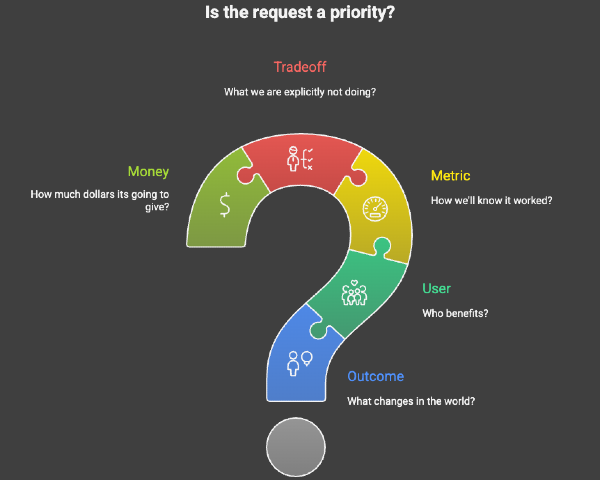
1) Create a “Prioritization Framework.”
Before any work starts, every request must include:
- Outcome (what changes in the world?)
- User (who benefits?)
- Metric (how we’ll know it worked)
- Tradeoff (what we are explicitly not doing)
- Money (how many dollars it's going to give)
If someone can’t fill this in, it’s not a priority. It’s a mood.
2) Enforce WIP limits at the initiative level
AI makes it easy to start 10 things. That’s exactly why you shouldn’t.
A simple rule that works shockingly well:
No more than 2 active “outcomes” per squad.
Everything else is draft-only.
Let AI generate drafts. Let humans commit to outcomes.
3) Add a “Kill Rate” to your leadership dashboard
Healthy teams kill work.
Track:
- # of initiatives stopped per quarter
- % of work deprecated before release
- time-to-kill (how fast you stop bad bets)
If your kill rate is zero, you’re not decisive—you’re just accumulating future regret.
4) Separate “can build” from “should build.”
With agents, “can build” is almost always yes.
So your gate must be “should”:
- Does it align with the quarter’s top metric?
- Does it reduce rework or risk?
- Does it unlock future speed (platform, tests, pipelines, Terraform module quality)?
- Is it small-batch shippable?
Faros has also pointed out a tension here: AI often increases PR size, while high-performing delivery benefits from smaller batches. faros.ai
So prioritization isn’t just what—it’s how you slice.
5) Build a “Golden Path” for AI-era infra and delivery
You mentioned Terraform modules + AWS pipelines. Perfect example.
AI can generate 5 different Terraform approaches in 5 minutes.
So your org must answer:
- Which module patterns are blessed?
- What’s the default pipeline template?
- What guardrails run automatically (security scans, policy-as-code, cost checks)?
- What’s the paved road, so engineers aren’t inventing infra styles as a side quest?
AI thrives inside constraints. Without them, it creates a buffet of inconsistency.
Use AI where it’s honest: options, not decisions
Let humans decide:
- What to ship this quarter
- What not to ship
- What “good” means (quality bar)
- What risk is acceptable
- What the team will be accountable for
That’s the balance.
AI isn’t replacing engineering. It’s compressing the time between “idea” and “artifact.”
So the manager’s job isn’t to write less code.
It’s to prevent the org from becoming a high-speed printer that only produces… noise.
The punchline: parallelism is cheap, but attention is still scarce
Your team can now do 47% more PR touches per day. faros.ai
Cool.
But your org still has:
- the same number of reviewers
- the same cognitive bandwidth
- the same appetite for change
- the same blast radius in production
- the same customers with the same patience
So in 2026 and beyond, the most valuable engineer won’t just be the fastest builder.
It will be the person (and the team) who can answer consistently:
“What matters most—and what are we refusing to do—even though we could?”
That’s prioritization.
And yes: it’s expensive now.